SMS is not dead - it is the very foundation - Why A2P SMS still stands firm in modern customer communication

It's easy to think that SMS is a thing of the past. In a world dominated by apps, push notifications, and richer messaging formats, SMS can seem simple and old-fashioned.
But after 25 years of message delivery in banking, commerce, logistics, emergency response, healthcare, and the public sector, I have learned one thing:
When the message really needs to get across, SMS is what businesses still rely on.

A market that is growing – not shrinking
Despite competition from new channels, demand for A2P SMS is increasing globally. Organic growth is positive and new service and application areas are emerging, often in line with innovation and the emergence of new areas where dialogue and communication are central.
The global A2P messaging market is estimated to be worth around USD 70-80 billion in 2024, with an expected growth to around USD 100 billion by 2030 at a CAGR of around 3-5%. Estimates from IMARC, MarketsandMarkets, Grand View Research and Juniper are all within these levels.
This does not represent niche use or reduction – but a robust and growing ecosystem.
Trillions of messages – in critical processes
Estimates from Juniper Research, among others, estimate that the global volume of A2P-SMS is in the range of 1.5–2 trillion messages annually , with continued growth in the coming years. The figures vary somewhat between analyses, but all point to the same thing: A2P-SMS is used massively in critical processes within banking, logistics, authentication and public service delivery.

This is not advertising and campaign noise. These are messages from:
banks and finance providers
retail and trade
electricity and energy
healthcare
critical services and emergency alerts from public authorities
This is the kind of communication we cannot afford to lose.
Where SMS still dominates
SMS has maintained its position in user journeys where:
Time, safety and delivery requirements are crucial
sender cannot control the recipient's technical requirements
The biggest uses today: ✔ One-time passwords (OTPs) and multi-factor authentication ✔ Transaction and account alerts ✔ Order, pickup, and delivery notifications ✔ Appointment and appointment notifications
✔ Emergency and disaster management ✔ Public sector and health alerts
All of these processes have one thing in common: they need to get there — and they need to do it quickly.
What makes SMS so robust?
SMS is successful because it:
✔ works on all mobile phones – regardless of age and manufacturer
✔ requires no app, account, update or user training
✔ delivered over controlled operator infrastructure
✔ works even where mobile data or WiFi is unavailable
This makes SMS the closest thing we have to “guaranteed compatibility”.
SMS + RCS + OTT: The role in a modern ecosystem
Digital messaging has evolved from a single channel to an entire landscape.
SMS
✔ universal range
✔ only requires mobile coverage
➡️ still the baseline channel in every customer journey and in information flows
RCS (Rich Communication Services)
✔ rich, interactive dialog, images, carousels, buttons
✔ delivered via operator network
✔ no app needed
🚧 but requires that the sender, operator and recipient have support
➡ a future primary channel – but not yet globally covered
OTT (WhatsApp, Messenger, Telegram, Viber)
✔ Actively used for customer dialogue in some countries
✔ Smart features (buttons, carousels, two-way dialogue)
🚧 Requires internet and installed app
🚧 Depending on user base per country
➡ Strong in markets with high receiver density, but not universal
The conclusion is simple: RCS and OTT build value on top of SMS – not instead of it.
SMS as infrastructure — not as a product
At Target365, we don't view SMS as "text messages." We view it as critical infrastructure , where quality is determined by:
smart routing options
direct operator integrations
scalability under load
fallback mechanisms
continuous measurement and monitoring
When the infrastructure works, it is not noticeable.
When it doesn't work, the customer journey and information flow stops — immediately.
The foundation for tomorrow's dialogue
The future belongs to combinations of channels:
SMS — the universal channel
Works for all receivers, on all phones and in all conditions.
RCS — interactive messaging experience
Provides buttons, images, and two-way dialogue — but coverage is still uneven across networks, receivers, and countries.
OTT — application-based messaging channels
WhatsApp for Business, Messenger, Telegram, Viber, etc.
Powerful and fast customer dialogues where users already are, but dependent on the internet and app choices.
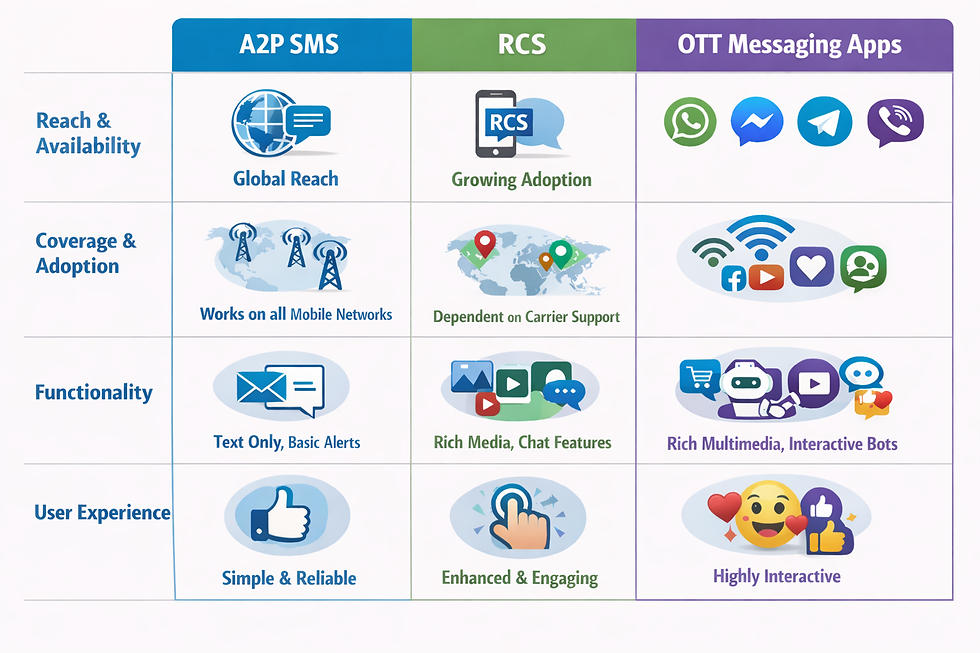
All of these are built on one premise: You need a channel that delivers – to everyone, always. And that’s why SMS is still the foundation and fallback in modern customer communication — while RCS and OTT represent the layers that are built on top.
Conclusion
SMS is not dead.
It has matured, but is growing and has become the foundation on which modern messaging dialogue is built.
It:
📌 used where it matters most
📌 has global reach
📌 works in all environments
📌 supports – and saves – the ambitions of richer channels
The technology doesn't have to be the most advanced to be the most important — it needs to deliver every single time.
That's why SMS is still the most reliable part of digital customer communication and information flow.


Comments